

Available on: Steam PC
Played on: Steam PC
I’ve played roguelike indie platformers, action-RPGs, and card battlers, but I’ve never seen a roguelike base builder like The King is Watching. By utilizing the unique King’s Gaze gimmick, The King is Watching transforms a base building strategy game into a tense, tightly focused roguelike experience.
Read on for our review of The King is Watching!
I’ll Be Watching You
Like most roguelikes, players will work to complete a single run, which includes over a dozen waves and multiple bosses. The tutorial provides some extra hand-holding during my first run. I drop some resource-production building into my limited-tile city, and see how my Gaze keeps them working.
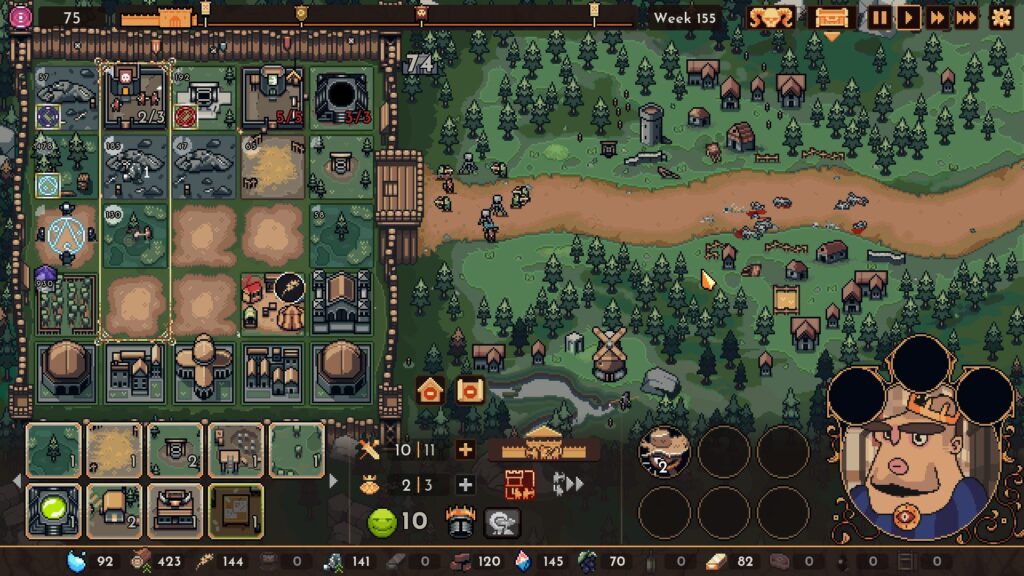
The first King’s Gaze is represented by a small L shape block of three tiles. My poor little kingdom is already limited to 16 spaces (before knocking out those pesky noble buildings through future upgrades), but I can only initially activate three at a time — those that fall under my Gaze.
The Gaze demands constant decision-making for optimization. Should I stick my troop barracks in the corners? I won’t need them until I have to replenish my army. Do I focus on wheat and water to build up my reserves? Do I need to quickly chop down some trees to afford a new building? Which combinations do I need to produce at the same time, and when do I need to switch to others?
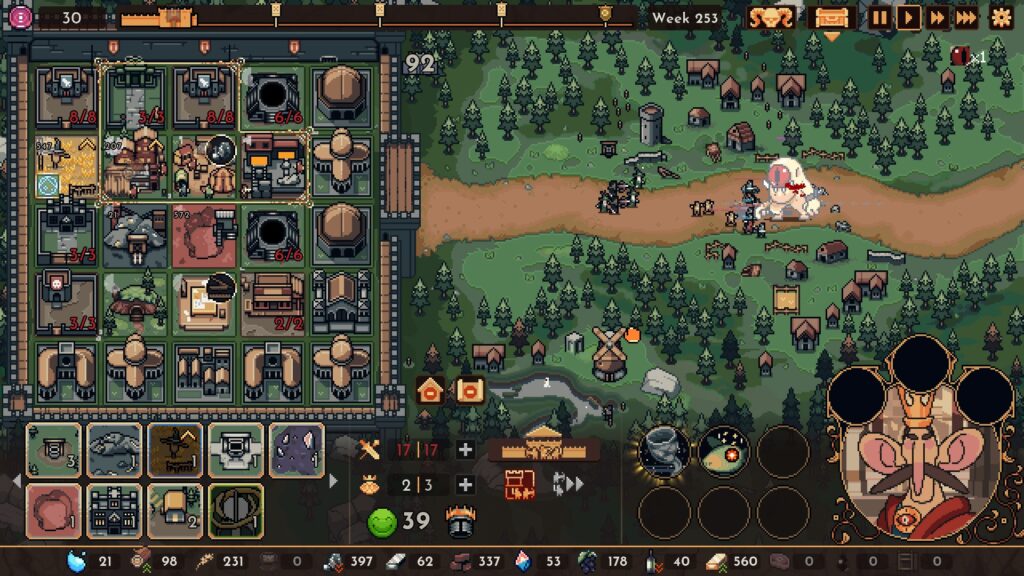
I love that everything takes place on a single screen, with my buildable kingdom on the left, and enemy waves approaching from the right. Resources are clearly labeled along the bottom, along with easy access to spells and information, including unit army breakdown, and pennant symbols for upgraded buildings. Big thumbs up to the art design and interface, which often makes or breaks a strategy game.
Most resource producing buildings are finite, which further complicates my placement and resource optimization, while each barracks building can only support so many units. Thankfully, buildings can be moved once placed, with a temporary penalty to their production.
Aside from affording new buildings and troops, I must constantly work towards two primary upgrades: army size, and Gaze size.
By increasing my army, I can field additional troops, which is paramount to surviving increasingly difficult waves of enemies. And by increasing my Gaze, I can expand its reach to cover more building tiles at once. A larger Gaze greatly increases my overall production, and making certain activated buildings, such as the Hospital (healing units) or Tavern (increasing morale, which boosts damage), more viable.
Enemy at the Gates
Waves of goblins, giants, and monsters relentlessly attack my city, though thanks to frequent prophecies, it’s up to me to schedule which groups arrive and in what order. I’m also free to increase the difficulty by adding additional enemy groupings, with increased rewards.
Rewards are randomized, adding to the challenge of each run, and sometimes, frustration. One time I ran out of my last wood-producing structure, creating a terrible bottleneck in my production. On the other hand, the random rewards also encourage me to adopt new strategies, such as using undead skeletons which only require water, or leaning harder into spells due to an early magic school and various upgrades.
Combat is automated between my troops and the enemy. My choices are largely focused on which troops to use based on which barracks buildings I’m able to grab and build, from archers to swordsman, and more exotic creatures like giant honeybees, shapeshifting druids, and killer geese.
Spells help add a little more interactivity to combat, offering one-time use effects like polymorphing enemies into harmless sheep, raining down meteors, or boosting my units’ damage.
If I can defeat the extra-powerful final boss, who arrives after about an hour of playtime, I can complete the run and gain extra rewards.
Between runs I can unlock different Kings with different abilities and Gaze sizes, advisors with powerful buffs, and new spells, barracks, and infrastructure for future runs. Even after a loss I still get some rewards — modern roguelikes are almost all roguelites, and I appreciate always making some progression and unlocking new content even after the more-likely (but still fun) failure.
 The Rating
The King is Watching has not been rated by the ESRB. We’d recommend an age rating of 13+ due to the bloody fantasy violence. Units are relatively tiny, but the battlefield is a bloody mess after each wave. Players can also produce and acquire wine as a resource, which is used to boost troop morale for bonuses.
The Takeaway
Don’t let that garishly red banner art turn you off, The King is Watching is a brilliantly fun strategy game with an incredible amount of depth and replayability. All the various levers, such as different kings with their own abilities, challenges, and Gazes, mixed with the roguelike nature of random buildings, rewards, and upgrades creates an endless supply of satisfying, if occasionally frustrating, real-time strategy.
Let us know what you think of our The King is Watching review on social media, and sign up for our weekly newsletter!