
Digital version: Steam PC
Release Date: Nov. 5
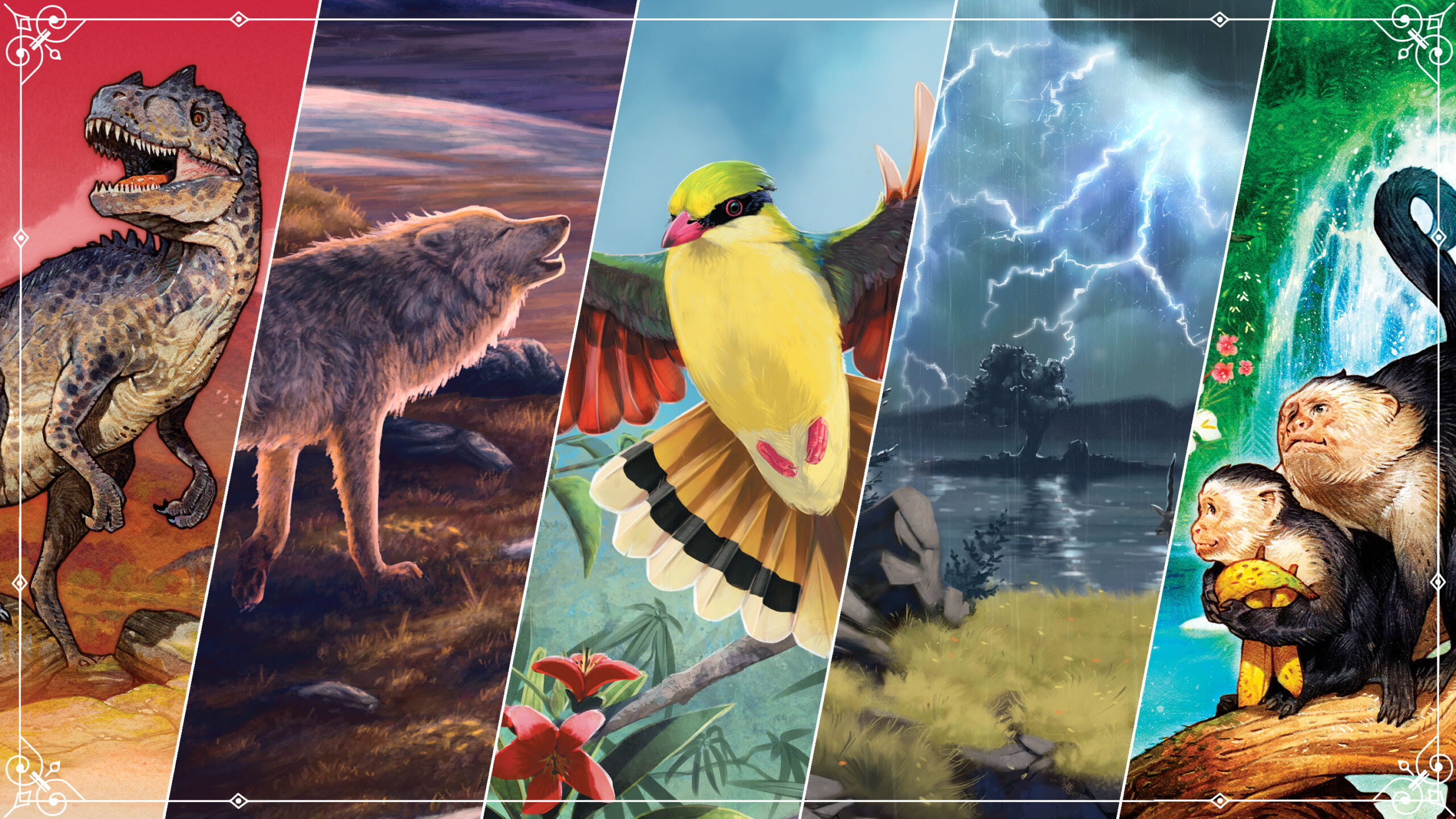
Nature is the recently redesigned version of 2014’s breakout tabletop game, Evolution, where players guide new species by selecting trait cards, growing their size, and keeping them fed to score points.
Over a decade later, NorthStar Game Studio and designer Dominic Crapuchettes have streamlined the strategy game with a faster play time, better rules, and a tighter balance. The new modular system allows players to choose exactly how complex they want each game through new traits and mechanisms, though each expansion is sold separately.
Read on for our review of the tabletop game, and digital adaptation, Nature!
Evolution Evolved
In the original Evolution game, players used their hand of cards to create new species, increase their population and/or size, and give them specific traits. Every round, species attempt to feed from the same watering hole (or each other!), mimicking the evolutionary arms-race found in, well, nature. Larger populations can eat more total food each round, while larger sizes can consume more food during a single turn. Traits give species special abilities to help them eat more, or defend against predators, or ambush other species.
At the end of the game, players scored victory points based on how much food they consumed, and their remaining species.
Nature improves on the classic game in several smart ways. To help feed their herbivores, players can now hold on to trait cards and play them for their food value during the round (instead of using those cards as traits, population, or size increases). Holding on to cards to ensure the maximum points can be critical, as can deciding when to play the card, potentially allowing other players to get extra food points as well.
Instead of having to decide when to create a new species, I’m simply given a new species each round, automatically. This creates a nice ramp up in complexity and decision-making, as well as populate the area with vulnerable newcomers for any predators.
Speaking of predators, no longer are players at the mercy of the card draw. The Hunter trait cards are now always available for anyone to grab and use, instantly transforming their species and allowing it to hunt others for food.
 Trait cards have also been overhauled, with almost every card being changed and updated. Trickier cards like Symbiosis, Intelligence, and Warning Call have been removed. Iconography is now clearer and easy to understand (Clawed gives +2 to Hunt, and +1 to Defense). There are fewer unique traits (in the base game), traits can now be duplicated, and creatures can easily become omnivores due to certain traits such as Scavenger or Tusked.
In fact, one of my favorite strategies is to eventually transform my first species into a powerful carnivore with the Clawed trait (or two), and have a bunch of smaller scavengers to feed off the carnage. Of course, hunters still need to overcome the many defensive traits of prey, and maintain their size-power advantage.
Losing a species could be quite painful in the original game, but Nature has an improved catch-up mechanic. Players with extinct species (whether hunted or starved) will receive all their trait cards back in their hand, and their new species on the next round will have the same population and size as the extinct ones.
Instead of scoring based on population or trait cards, each individual species scores two bonus points at the end of the game, prioritizing players to protect them as much as possible, while still scoring the maximum amount of food each round.
Nature Trail
Compared to the original Evolution, Nature may feel simplified and stripped down. The new version includes only eight different trait cards (nine if we include Hunter), compared to Evolution’s 17.
That’s where the new modular system comes into play.
At launch, Nature has two available expansion sets: Flight, and Jurassic. Each set is sold separately, adding new cards and concepts to the game.
 Flight adds five new traits and avian species to the mix, letting players choose each round if they want to add a normal land-lubber, or an avian creature. Flying creatures cannot be hunted except by other flying creatures (or those with the new Camouflage trait), and grow faster thanks to the Migrating rules.
The Flight expansion is great for players who want a more defensive, less cutthroat game, as birds are naturally harder to hunt.
At the other of the spectrum is the Jurassic expansion, which is all about creating bigger and badder species. All Jurassic creatures start at size two and increase by two instead of one, and increase the previous species size limit of four up to a whopping 10! New hunter cards allow predators to become Clever or Apex to help overcome bigger and more powerful defensive prey.
Needless to say, there’s a lot more hunting and carnage with Jurassic, for players who don’t mind more direct interaction.
More modular expansions are on the way, including Natural Disasters and Arctic Tundra arriving later this year, and Amazon Rainforest in March 2026. North Star Games recommends adding only one or two expansions to each game to keep things running smoothly, and trait decks are kept separately, letting players choose when to draw the new cards.
 Island Getaway
The digital version of Nature is built from the 2019 Evolution digital adaptation from NorthStar Digital Games, and includes local matches with players and AI, online matchmaking, and a full single player campaign.
As with the Evolution app, the watering hole dynamically changes depending on how much food is present, and AI opponents play quickly from their types, including Fertile, Defensive, and Balanced. I also love when hunters grow claws and attack others, or when birds fly away for migration. The digital version also automatically keeps track of size fluctuations due to traits, and highlights which creatures are valid targets when hunting. I can easily play an entire solo match in 10 minutes.
The campaign features dozens of levels along a linear track through an island, and each modular pack adds another island with even more missions.
In addition to standard face-offs and challenging “boss fights,” the campaign features plenty of fun mix-ups and challenges, such as playing with only Flight cards (in the flight campaign) or playing in reverse and starting with five species and trying to keep them alive. One particularly interesting challenge tasked me with remaining in last place (with visible points) for at least two rounds before winning a come-from-behind victory.
Getting gold stars on each mission is a challenging achievement, and the entire campaign can be played in Normal or Hard difficulty, offering lots of solo playtime.
The Rating
Nature the board game has a recommended age rating of 10+. It’s slightly lower than Evolution (12+), thanks to its easier rules, better balance, and fewer trait cards. Younger and newer players can readily enjoy the base game. Once mastering Nature, players can pick and choose more complexity via the optional modules.
The Takeaway
If you weren’t already a fan of Evolution’s basic game design, Nature won’t suddenly convert you. The basic strategy of managing cards and species is still there, but Nature’s many improvements represents one of the best 2.0’s of a board game I’ve ever seen. From the always-available Hunter cards to mid-round card-feeding to automatic new-species-per-round, Nature brilliantly improves upon the original game in every way.
The glaring caveat is having content cut up and split into multiple expansions, making it feel like a smaller game with less variety than the original 2014 box (Nature is priced cheaper, as well). On the other hand, each of the modules (of the two we reviewed) provides a solid amount of changes that reflect their themes, and worth the investment for fans wanting a greater, and more complex, variety.
Let us know what you think of our Nature review on social media, and sign up for our weekly newsletter!