
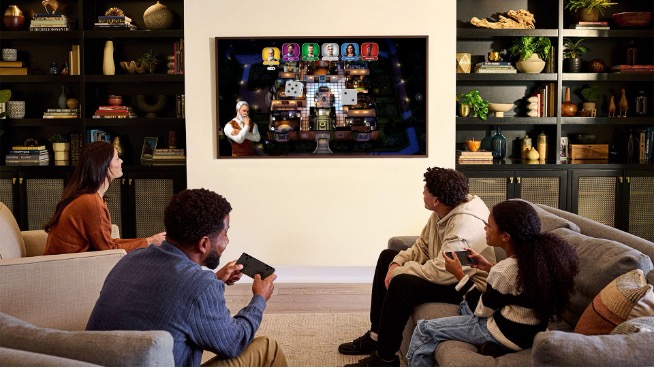
Samsung Gaming Hub is aiming to bring families together this holiday season, through smart TVs, Amazon, and smartphone connectivity.
Recent research from an Ipsos Samsung Gaming Hub survey found that 79% of parents with they were spending more quality time with their children — and that 84% admit to using their mobile devices during family time.
“So often, everyone in the family is on a different screen, often together in the same room, yet completely consumed in their own activity,” said Marie Shanley, Digital Well-being Consultant. “Technology doesn’t have to be something that pulls families apart. When it gives us a reason to laugh, compete and participate together, it can actually become a tool for connection, turning screen time into time spent engaging with each other.”
Samsung Gaming Hub transforms the living into an instant gaming space, simply by using a smart TV, and personal mobile devices. Thousands of games are accessible from Amazon Luna, including board games and party games. By selecting a GameNight title, everyone’s smartphones become the controllers to play along. GameNight, along with a rotating library of games on Luna, are available to Amazon Prime members at no additional cost.
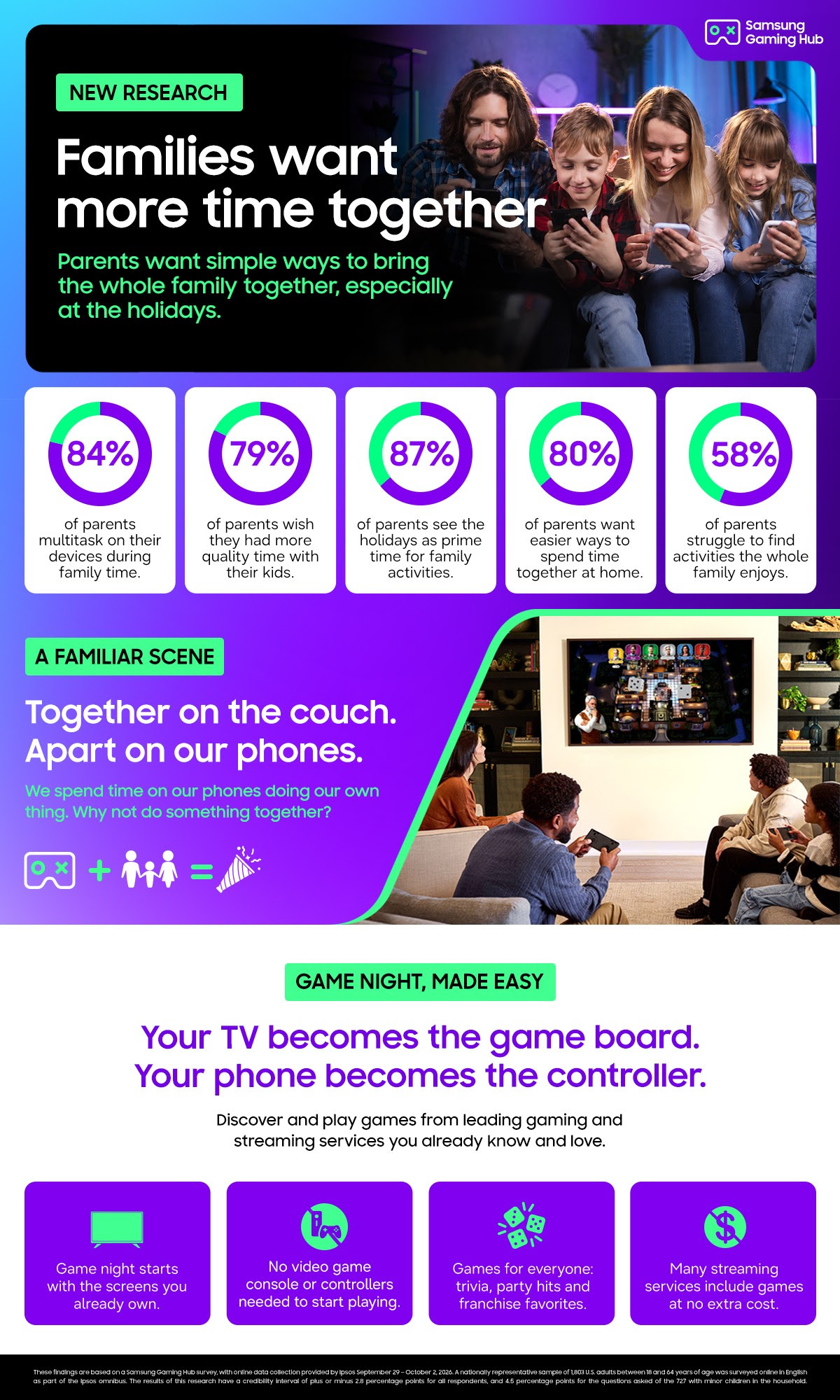 Other gaming services supported by Samsung Gaming Hub include Xbox, GeForce Now, Antstream Arcade, and Blacknut Cloud Gaming. The Gaming Hub also supports bluetooth or USB controllers.
Samsung Gaming Hub is free, and integrated into Samsung Smart TVs from 2022 onward, as well as select monitors and projectors.
“There’s something special about bringing family and friends together around a game,” said Kevin Beatty, Head of Product, Samsung. “It’s the laughter, the friendly competition, and the shared moments that make it memorable. We’re seeing a new era of family game night, where anyone can jump in and play together right on their TV. And families are embracing it – over the past year, we’ve seen unique users playing casual and party games on Samsung TVs grow more than 90% in North America and more than 200% globally.”
The Ipsos research is based on online survey data collected in October 2026 from 1,803 adults between the ages of 18 and 64.